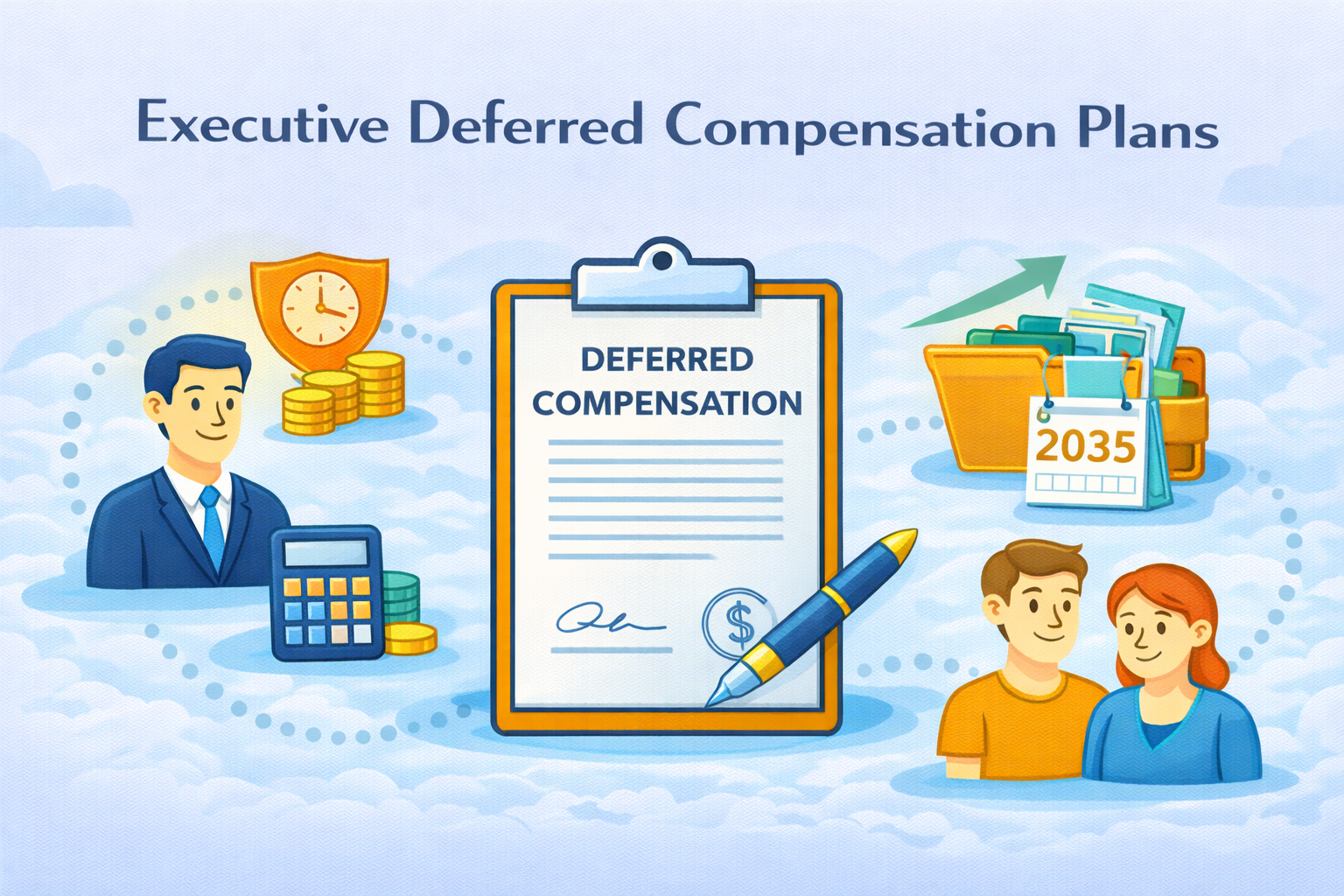
Executive Deferred Compensation Plans
Strategic Planning for Non-Qualified Compensation
One of the more complex—but potentially powerful—employee benefits available to executives is a non-qualified deferred compensation plan, often referred to as a top-hat plan. These plans are typically offered only to select executives and senior leaders and are designed to provide additional compensation beyond traditional retirement plans.
Because these plans are non-qualified, they are not standardized like 401(k) plans. Each plan is unique to the employer, which makes understanding the rules, risks, and elections critically important.
How Executive Deferred Compensation Plans Work
Deferred compensation plans generally function in one of two ways:
Voluntary Deferrals
Executives elect to defer a portion of their salary or bonus into future years.Employer-Funded “Golden Handcuffs” Arrangements
The employer contributes compensation on behalf of the executive that is not accessible until a future date. If the executive leaves before that date, the deferred compensation may be forfeited—hence the term golden handcuffs.
These plans allow executives to shift income from high-earning years into lower-income years, often after retirement.
Tax Advantages of Deferred Compensation
Deferred compensation can be particularly valuable for high-income executives.
For example:
Receiving compensation in a year with already high income can subject it to top marginal tax rates.
Deferring compensation until retirement—and spreading it over several years—can significantly reduce the overall tax burden.
When structured properly, deferred compensation can be an effective tax-deferral and income-smoothing strategy.
Understanding the Risks
Unlike qualified retirement plans, non-qualified deferred compensation is not guaranteed.
Key risk considerations include:
Deferred amounts must remain available to the employer’s creditors
If the company becomes insolvent or declares bankruptcy, the deferred compensation may be lost
If the executive voluntarily leaves or is terminated prior to the vesting date
Because of this, deferred compensation represents concentration risk in both income and employer stability.
Evaluating the financial strength and long-term viability of the employer, as well as the expected tenure of employment with the company, is a critical part of the planning process.
Distribution Elections Matter
One of the most common planning mistakes we see is how executives elect to receive their deferred compensation.
Many plans require annual elections specifying:
When payments will begin
Whether distributions will be paid as a lump sum or over time
Executives often default to a lump-sum payout shortly after separation from service. If an executive has been deferring compensation for many years, this can result in:
A massive single-year income spike
Exposure to the highest tax brackets
Loss of the intended tax benefit of deferral
Careful election planning can spread income over multiple years and better align with retirement cash-flow needs.
Coordination With a Comprehensive Financial Plan
Deferred compensation should never be evaluated in isolation.
We help executives integrate deferred compensation into:
Retirement income planning
Tax strategy
Cash-flow projections
Social Security and Medicare planning
Investment and risk management strategies
Because elections are often irrevocable once made, planning must be done before decisions are finalized.


Our Deferred Compensation Plan Articles



“I just got that option from my employer, your video made me think twice! Thanks!”
This endorsement provided for Greenbush Financial Group, LLC on YouTube was a non-solicited and non-paid comment by a non-client.
“One of the most concise and helpful explanations of what a NQDCP is and how it works. Thank you!”
This endorsement provided for Greenbush Financial Group, LLC on YouTube was a non-solicited and non-paid comment by a non-client.
Frequently Asked Questions About Executive Deferred Compensation Plans
-
What is a non-qualified deferred compensation plan?It is a benefit plan that allows executives to defer compensation to future years outside of traditional retirement plans.
-
How is deferred compensation taxed?Deferred compensation is generally taxed as ordinary income when it is paid, not when it is earned.
-
Is deferred compensation guaranteed?No. Deferred compensation remains subject to the employer’s creditors and can be lost if the company becomes insolvent.
-
Why are these plans called “golden handcuffs”?Because executives may forfeit deferred compensation if they leave the company before certain conditions are met.
-
Can deferred compensation reduce taxes?Yes, when income is shifted from high-earning years to lower-income years, overall taxes may be reduced.
-
What is the biggest mistake executives make with deferred compensation?Electing lump-sum distributions that create large tax liabilities in a single year.
-
How should deferred compensation fit into retirement planning?It should be coordinated with other income sources to manage taxes, cash flow, and Medicare premiums.
-
Should executives review deferred compensation annually?Yes. Elections, company stability, and personal financial goals can change over time.
Contact Us . . . .

All of our services start with a complimentary consult. No high pressure sales tactics. We are financial planners, not salesmen.
About Our Firm: Greenbush Financial Group is an independent registered investment advisory firm based in Albany, New York, that provides four main services to clients: fee-based financial planning services, investment management, employer-sponsored retirement plans, and retirement planning services. The firm serves clients locally in the Albany region and virtually across the United States.