Roth Conversion Strategies
A Powerful Tool for Tax-Free Wealth Accumulation and Legacy Planning
When used correctly, Roth conversions can be one of the most powerful tax-free wealth accumulation strategies available. The opportunity typically arises during lower-income years, which often occur either in early retirement—when paychecks stop—or when there is an abnormally low income year during the working years.
By intentionally converting pre-tax retirement dollars into Roth dollars during these periods, individuals can potentially lock in lower tax rates today and allow all future growth to occur tax-free. When coordinated properly, Roth conversion strategies can reduce lifetime taxes, lower Medicare premiums, shrink future required distributions, and significantly enhance the value of assets passed to the next generation.
At our firm, Roth conversions are an integral part of the retirement planning and financial planning process for many clients.
How Roth Conversions Work
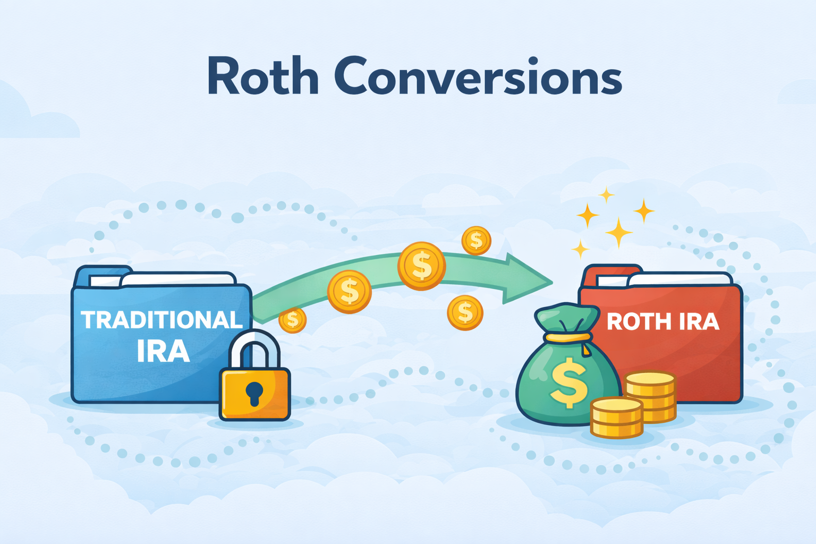
A Roth conversion involves moving money directly from a pre-tax retirement account—such as a Traditional IRA—into a Roth IRA.
Key mechanics of a Roth conversion include:
The amount converted is taxable as ordinary income in the year of conversion
The converted funds continue to grow tax-free inside the Roth IRA
Roth conversions do not incur the 10% early withdrawal penalty, even for individuals under age 59½
Once inside the Roth IRA, qualified withdrawals are tax-free
This makes Roth conversions especially attractive for retirees who find themselves in lower tax brackets after leaving the workforce.
Why Roth Conversions Are Especially Powerful in Retirement
For many retirees, the years between retirement and the start of Required Minimum Distributions (RMDs) represent a unique planning window. During this time:
Employment income has ended
Social Security may not yet be claimed
Taxable income is often significantly lower than during working years
These lower-income years can allow retirees to intentionally fill lower tax brackets with Roth conversions rather than waiting for future years when income may spike due to RMDs, Social Security taxation, or pension income.
Strategic Roth conversions during this period may:
Reduce future federal and state taxes
Lower future Medicare premiums (IRMAA)
Reduce or eliminate future RMDs from pre-tax accounts
Improve after-tax retirement cash flow
Determining the Optimal Amount to Convert Each Year
Identifying the right amount to convert annually is the most complex—and most important—part of a Roth conversion strategy. There is no one-size-fits-all answer.
This analysis requires detailed financial and tax planning and may include consideration of:
Other income sources (pensions, part-time work, investment income)
Federal tax bracket thresholds
State tax treatment of Roth conversions
Whether a state excludes a portion of Roth conversions from taxation
Medicare IRMAA income thresholds
Future RMD exposure
Social Security filing strategy
Expected longevity and spending needs
Converting too much can push a retiree into higher tax brackets or higher Medicare premiums. Converting too little can leave significant pre-tax balances that create higher taxes later. The goal is to optimize, not maximize, conversions.
Roth Conversions and Multi-Generational Planning
For retirees who do not expect to spend all of their pre-tax retirement assets, Roth conversions can play a critical role in legacy and estate planning.
Under current IRS rules, non-spouse beneficiaries of inherited retirement accounts are generally subject to a 10-year distribution rule. Inherited pre-tax accounts must be fully depleted—and taxes paid—within that 10-year window, which can force beneficiaries into higher tax brackets.
By contrast, when beneficiaries inherit a Roth IRA:
Withdrawals are generally tax-free
RMDs are typically not required during the 10-year period
Assets can continue to grow tax-free for up to 10 additional years
The entire balance can be withdrawn tax-free at the end of the 10-year period
This effectively gives heirs extra years of tax-free compounding, making Roth assets significantly more valuable than pre-tax assets for inheritance purposes.
Coordinating Roth Conversions With Social Security
For clients pursuing Roth conversions, it can sometimes make sense to delay Social Security until Full Retirement Age or age 70.
Because Social Security benefits may be subject to federal taxation, claiming benefits early can fill lower tax brackets that might otherwise be used for Roth conversions. By delaying Social Security, retirees may preserve more room in lower brackets to convert pre-tax dollars while allowing Social Security benefits to continue growing.
This coordination is highly individualized and must be modeled carefully as part of an integrated retirement plan.
Our Approach to Roth Conversion Planning
At Greenbush Financial Group, Roth conversion strategies are never implemented in isolation. We integrate them into a comprehensive planning framework that includes:
Long-term retirement projections
Tax bracket and IRMAA modeling
Social Security optimization
RMD planning
Distribution and withdrawal strategies
Estate and legacy planning
Our goal is to help clients use Roth conversions intentionally and strategically, rather than reactively.



Our Roth IRA Articles

“I reached out to Mr Ruger for a question regarding Roth IRA and he promptly responded with helpful information and recommendation of a cpa that could help me with my situation.⭐⭐⭐⭐⭐”
This endorsement provided for Greenbush Financial Group, LLC on Google Review was made by a non-client, and it was a non-paid review. This non-client was solicited by Greenbush Financial Group, LLC to provide the endorsement.
“If you need any type of financial advise, this is the place to go see. Michael at Greenbush Financial Group was able to provide me a wealth of information about specific Roth IRA questions I had. He was super friendly and you can tell, they are passionate about anything finance when it comes to preparing for retiring through your lifetime, and also in other areas. Go see them today! ⭐⭐⭐⭐⭐”
This endorsement provided for Greenbush Financial Group, LLC on Google Review was made by a non-client, and it was a non-paid review. This non-client was solicited by Greenbush Financial Group, LLC to provide the endorsement.


“OK. I’ve listened to a dozen or so Roth presentations. This guy’s INFORMATION is outstandingly to-the-point, ACCURATE, and impactful - he covers all the relevant topics. EXCELLENT. I almost made the mistake of skipping it because it was plain (not “slick”). Top quality. Fine. Thank you.”
This endorsement provided for Greenbush Financial Group, LLC on YouTube was a non-solicited and non-paid comment by a non-client.
Frequently Asked Questions About Roth Conversions
-
What is a Roth conversion?A Roth conversion is the process of moving money from a pre-tax retirement account into a Roth IRA, paying taxes now in exchange for tax-free growth and withdrawals later.
-
Do Roth conversions incur a 10% early withdrawal penalty?No. Roth conversions are not subject to the 10% early withdrawal penalty, even if you are under age 59½.
-
When is the best time to do Roth conversions?The best time is typically during lower-income years, often after retirement but before RMDs and Social Security begin.
-
How much should I convert each year?The optimal amount depends on tax brackets, other income, state taxes, Medicare thresholds, and long-term goals. This requires careful planning.
-
Can Roth conversions reduce Medicare premiums?Yes. Strategic conversions can help reduce future income spikes that would otherwise increase Medicare IRMAA premiums.
-
Are Roth conversions good for estate planning?In many cases, yes. Roth IRAs are often more valuable for heirs because distributions are typically tax-free and can continue growing for up to 10 years after inherited.
-
Should I delay Social Security if I’m doing Roth conversions?In many cases, yes. Delaying Social Security may preserve lower tax brackets for Roth conversions and increase lifetime benefits.
-
Are Roth conversions for everyone?No. Each individual needs to weigh their various financial goals and tax strategy to determine whether or not processing a Roth conversion makes sense.
Contact Us . . . .

All of our services start with a complimentary consult. No high pressure sales tactics. We are financial planners, not salesmen.
About Our Firm: Greenbush Financial Group is an independent registered investment advisory firm based in Albany, New York, that provides four main services to clients: fee-based financial planning services, investment management, employer-sponsored retirement plans, and retirement planning services. The firm serves clients locally in the Albany region and virtually across the United States.